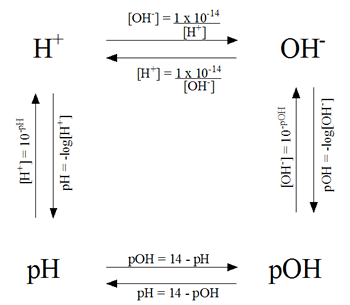
Actually, today’s lesson was very interesting! We were able to determine the pH of the a lake before and after acid rain fell on it. To do this, we needed the following equation:
Today, the topic was ion concentration. We’ve already learned about the concentration of substances and molarity in this unit, so we’re going to move onto the concentration of specific ions.
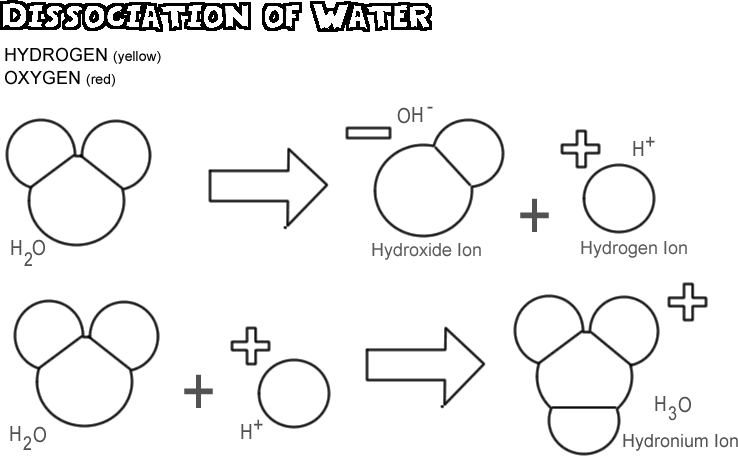
As we’ve learned before, ionic compounds are made up of two parts. The first part is the cation, which is the positively charged particle. The second part is the anion, which is the negatively charged particle. When dissolved in water, these two particles separate from each other. This process is called dissociation.
The top equation is dissociation, while the bottom is the opposite.
When writing dissociation equations, the atoms and charges must both be balanced.
Ex.) Write the dissociation of Sodium chloride.
NaCl(s)à Na+(aq) + Cl-(aq)
Ex.) Write the dissociation for Na3PO4.
Na3PO4à 3Na+ + PO43-
If the volume of the solution does not change, then the concentration of individual ions depends on the balanced coefficients in the dissociation equation.
Ex.) Determine [Na+] and [PO43-] in a 1.65 M solution of Na3PO4.
Na3PO4à 3Na++ PO43-
As always, we must start with a balanced equation. Next, we convert 1.65 M to moles, and then use our molar ratios to find the number of moles of both ions. Finally, we divide by the volume. When it doesn’t tell us, we can assume it’s 1L.
1.65 M x 1 L/mol = 1.65 mol
1.65 mol x 3/1 = 4.95 mol x 1/L = 5.0 M [Na+]
1.65 mol x 1/1 = 1.65 mol x 1/L = 1.7 M [PO43-]
Done!
Ex.) A 0.100 L solution of 0.500 M PbCl2 is added to 0.200 L solution of 0.100 M NaOH. Determine the final [Cl-].
PbCl2 + NaOH à Pb+ + 2Cl- + Na+ + OH-
Just like we did before, a balanced equation is necessary. In this equation, we need to add the volumes to find the total volume. The total volume is 0.300 L. We only need to calculate the concentration of PbCl2, so we can just disregard the other parts.
0.500 M x 0.100 L/mol x 2/1 x 1/0.300L = 0.333 M [Cl-]
Today’s class was rather blue. That is, the solutions were. But, they had different shades, and of course, this was no coincidence. We were told these were solutions of copper (II) chloride, or cupric chloride.
Our task was to figure out which of the solutions corresponded to 0.1 M. No problem, we said! We decided to quickstyle this lab.
The items we worked with included the following:
Copper (II) chloride
Scoopula
Weight
Plastic container
Beaker
Erlenmeyer flask
Graduated cylinder
Here is the procedure:
1. Obtain your needed materials listed above.
2. Weight out 1.345g of CuCl2.
3. Measure 100mL of water in a graduated cylinder.
4. Mix these two substances in an Erlenmeyer flask (it’s fun to spin).
5. Pour into test tube and compare with test tube species.
How we obtained 1.345g?
Simple. To receive a molarity of 1.0, we know that there are 1.0 moles of CuCl2 in 1L. To receive our desired molarity, 0.1, we have 0.1 in 1L. Since one liter is a bit too much, we simply keep our ratio the same, of moles and liters, but decrease the numbers by 10. Now we have 0.01 moles in 100 mL. How many grams is this? Simply molar mass of CuCl2 will tell us.