There's not much to talk about. Remember that blog on esterfication? It's pretty much the same thing. Except, instead of writing out esterfication equations, WE ACTUALLY DID THEM!
Look how much fun esterfication can be?
Our first step was to take the carboxylic acid and the alcohol and mix 'em. After, we added some sulfuric acid (the special ingredient) and heated the solution close to a boil. Our esterfication reactions produced an ester and water. The esters had special properties; they smelt like everyday objects! Esters are responsible for the smells of banana, orange, rum, perfume, and more! Here's one that we made:
There's not much else to say. If you'd like to learn more about esters, view our previous post.
An ester
is an organic compound made by replacing the hydrogen of an acid by an alkyl or
other organic group. For our studies, it is formed through the combination of a
carboxylic acid and an alcohol. The hydroxyl groups combine to form water and
our ester. The ester has a double bonded oxygen as well as a single bonded one
to the same carbon. It has the ending
–anoate.
The ‘parent’ chain is where the oxygen atoms want to give a hug.
To name an
ester:
The
hydrocarbon chain directly attached to the carbon side of the COO group has the
ending –anoate. Then normally name the 'side' chain.
Esterification
is the reaction of a carboxylic acid and an alcohol to form water and an ester.
In order for them to be formed, we need an inorganic acid. After some magical
chemical reactions, we are left with the pleasant smell of the ester. A few
smells are:
Ethyl methanoate:
rum *yum*
Methyl
butanoate: pineapples
Pentyl
ethanoate: banana
Now it’s
time to draw. Draw:
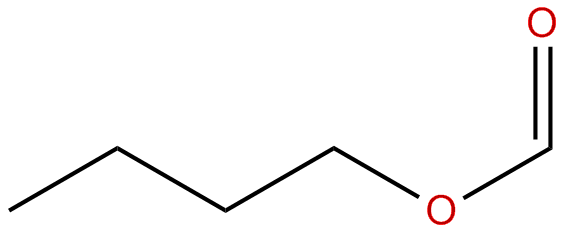
Butyl
methanoate
Ethyl propanoate:
Esterification: Label the diagrams and determine a
relationship between the reactants and products.
The reactants are methanol and butanoic acid.
The products are water and methyl butanoate.
The relationship: butanoate = butanoic acid / methanol =
methyl.
In this way, the alcohol forms the ‘side chain’ and the
carboxylic acid forms the parents.
Amides: CONH2
is the amide group. Ending is –(an)amide. Ie. Benzamide.
Nitro:
contains NO2 which has resonance. It is not a parent chain.
Esters:
contain a =O and a –O on the same carbon.
And there
you have it! Let’s try identifying some now.
Amines:
Name:
This
compound is phenyl amide. Another common name is aminobenzene.
Amines can
be named in many ways. You can have methylamine, methanamide, or aminomethane
and they are all the same. You can sometimes have the amine be a parent chain.
Amides:
Amides contain a double bonded oxygen and nitrogen both attached to a carbon.
Notice in the diagram there are NH2 molecules. Other than hydrogens
in those spots, we can have more carbon chains. This functional group contains
CONH2; it’s the amide group.
Inspect:
Molecules
containing amides end in –amide. The prefix is simply the number of carbons
(including the one in the amide group).
Nitro:
functional group if NO2. It has alternating single and double bonds.
It is not used as a parent chain. It has a simple side chain called ‘nitro’ and
is preceded in a molecule with a locant.
Name:
It is: 2-methyl,
1,3,5 trinitrobenzene. It is also called trinitro tuolene, or in other words,
TNT.
Today, we continued our work with naming groups. Last class,
we went over the rules for naming. This class we mostly did examples.
One important addition: carbon chains without functional
groups are often abbreviated as R. For example, R-OH would be alcohol.
Here are the examples we went through:
Ex.) Draw: 2, 3 diphenyl 3 ethyl 1, 5 pentadiol
To draw this compound, first draw the parent chain. Afterwards, attach two OH groups to carbons 1 and 5 on the parent chain. Finally, add two benzene side chains and an ethyl at the appropriate places.
Ex.) Draw: Phenol
This is a special compound. Phenol consists of a benzene attached to a single OH group.
We also learned about aldehydes. Like ketones, aldehydes
have an oxygen double bond. However, in this case, the oxygen is bonded on the
end. The suffix for the compound is ‘-al’.
The simplest form is methanal, which is better known as
formaldehyde.
We also started our study of other functional groups.
The first one we learned of is carboxylic acid.
For carboxylic acids, there is a double bonded oxygen (an
aldehyde) and an alcohol functional group on the last carbon. The suffix for this
compound is ‘-ioc acid’.
Ex.) Draw: 3 chloro 2 methyl butanoic acid
To draw this compound, first draw the parent chain. From there, add the OH group and the double bonded oxygen on the first carbon. Finally, add your side chains. Done!
That’s it for today’s lesson. Next class, we can expect to continue learning about functional groups.
Carbon is capable of forming 2 kinds of closed loops.
Alicyclics are loops usually made with single bonds. If the parent chain is a
loop, standard naming rules apply (except ‘-cyclo’ is added before the parent
chain).
In this example, we have cyclopentane. It’s simple, as there
are no side chains.
Numbering can start anywhere, but side chain numbers must be
the lowest possible.
Here are a few more examples:
Ex.) Draw: 1, 3, 5 trimethyl cyclohexane
This one is pretty easy. First, we draw the cyclohexane (which is a carbon chain of 6 with the ends connected). We then add side chains (methyl) at three spots. Easy.
Ex.) Name:
The parent chain here is cyclobutane. There are 2 methyl side chains, both at position 1. Therefore, the name is 1,1 dimethyl cyclobutane.
Loops can also be in side chains. The same rules apply for
naming, except the side chain is given the ‘cyclo-‘ prefix.
Here's an example:
Ex.) Draw: 2 methyl 3 cyclopropyl pentane
This is done by first drawing the parent chain (5 carbons). Then, we add the methyl at the 2nd carbon. Finally, we add the cyclopropyl at the third carbon. Done!
Benzene (C6H6) is a cyclic hydrocarbon with unique bonds
between the carbon atoms. Structurally, is can be drawn with alternating double
bonds:
In the case of benzene, all 6 carbon-carbon bonds are
identical and really represent a 1.5 bond all around. This is due to electron
resonance. Another way to thing about it is that the electrons are free to move
all around the ring. We can draw benzene like so:
Benzene can be a parent chain or a side chain. As a side
chain, it is called ‘phenyl’.
Here's an example with benzene:
Ex.) Draw: 1, 2, 3, 4, 5, 6 hexamethyl benzene
First, draw the benzene. Then, simply add 6 methyls.
As we know
by now (or should know), carbon can form double or triple bonds with other
carbon atoms. When there are only single bonds present, it is considered a saturated compound,
because all possible bonds are bonded to other atoms. On the other hand, double
or triple bonds, present in alkynes and alkenes, are unsaturated. When there
are multiple bonds, fewer hydrogens are attached to the carbon atom.
The rules
for naming alkenes and alkynes are almost identical.
However, remember this: The position of the double/triple bonds always has
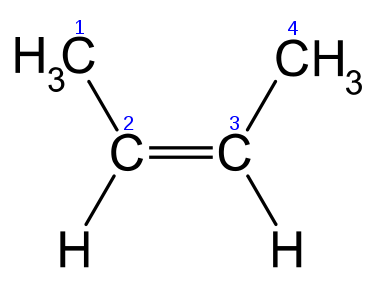
the lowest number and is put in front of the parent chain. For example, in
the photo below:
This
molecule consists of four carbons. The double bond occurs at 2.
Therefore, this is 2-butene.
Let's
review some of the rules, just in case:
Find the
longest, appropriate parent chain
Number the
base chain so that side chains have the lowest total value
Name each
side chain
Add some
numbers
List the
side chain alphabetically (if you encounter the same letter, then the one with
the lowest number takes precedence)
If you
have two or more double/triple bonds present, you will need to add a multiplier
right before the '–ene'/'-yne' ending.
That is
it! Let's try one:
Name this:
Let's
count the parent chain: It consists of four carbons.
Lowest
numbering of alkenes: 1,3
Therefore,
this is: 1, 3 butadiene
There are
also these fancy structures that go by the name of –cis and –trans. This
applies only to alkene groups, specially butene (but not restricted to it).
If the
adjacent carbons are on the same side, then its cis ___. If it’s on the
opposite sides, it is trans ____. There is also a possibility that it is
neither cis nor trans. How does that look? Well, try it out yourself.
Organic chemistry is the study of carbon compounds. As we
know, carbon can form four covalent bonds. This property allows it to form long
chains, rings or branches with other carbon compounds. The variety and number
of compounds carbon can form is astounding! It’s interesting to note that there
are 17 000 000+ organic compounds, but less than 100 000 inorganic compounds.
The simplest organic compounds are made up of carbon and
hydrogen.
CH4
CH3CH3
As you can see above, there are two ways to write the
formula for a compound: condensed and structural. For example, CH3CH3
would be the condensed formula, while the image shows the structural formula.
We also learned that saturated compounds have no double or
triple bonds. The compounds with only single bonds, which we are currently
studying, are called alkanes and always end in ‘-ane’.
Another note: isomers are different compounds with the same empirical
formula (like C5H2).
There are 3 types of organic compounds:
Straight Chains
Cyclic Chains
Aromatics
We focused solely on straight chains today.
To name them, first circle the longest continuous chain and name this as the
base chain.
For example, in the following compound, there is a 7 carbon
chain. The longest chain can be identified as the longest path that can be made
without going over the same carbon twice. Since there are 7 carbons, we can use
the prefix ‘hept-‘ to identify the chain. Here are the guidelines for naming
the chains:
1 carbon – meth
2 carbons – eth
3 carbons – prop
4 carbons – but
5 carbons – pent
6 carbons – hex
7 carbons – hept
8 carbons – oct
9 carbons – non
10 carbons – dec
We also know that there are only single bonds, so the suffix
is ‘-ane’. Therefore, the compound’s primary name is ‘heptane’.
We must also name the side chains. We must number the side chains
so that they have the lowest possible aggregate number. Here, we would start
counting from the left. The side chains are only one carbon long, so they take
the prefix ‘meth-’ and the suffix ‘-yl-. There are three of these, so we give
it another prefix: ‘tri-’.
Following all of these rules, the compound is 3, 3, 5
trimethyl heptane.
With that out of the way, now we can do some examples.
Ex.) Name:
This one is pretty easy. The parent chain is 5 carbons long, so it is pentane. Then, numbering properly, we get 2, 2 dimethyl for the side chains. Therefore, the compound is 2, 2 dimethyl pentane.
Ex.) Draw: 2, 2 dimethyl hexane.
This one is also very easy. First, draw the parent chain. Then, simply add a methyl at the second carbon in the chain:
Today’s lab had a catch to it; it’s didn’t smell too well. But that was no problem, as our group quickly set up six test tubes. Three were filled with water, and the other three with turpentine (paint thinner). Why did we set this up? Well, we wanted to know if glycerin is polar or non-polar.
We added table salt to a test tube AW (water) and to AT (turpentine). We did the same with sugar and crystals of iodine. What did we notice after some shaking? Well,
Table Salt and sugar both dissolved in water, whereas iodine (I2) did not.
Iodine dissolved in paint thinner, whereas table salt and sugar did not.
We knew that water was polar and that turpentine was non-polar. In addition, we knew that table salt and sugar were polar and iodine was not. Therefore, since polar substances dissolved only in polar substances, we knew there was a connection. In addition, since non-polar substances dissolved only in non-polar substances, we discovered what was going on.
Like dissolved Like. Polar dissolves polar; non-polar dissolved power.
With this power in hand (knowledge is power), we set off to find out whether glycerin is polar. After adding it to water and shaking, it dissolved. Therefore, it was polar. We could have further explored this, but the turpentine ran out. But we can imagine what would happen. Since turpentine is non-polar, and glycerin turned out to be polar, then glycerin would not dissolve in the turpentine.
As we learned from the lab, only ‘like dissolves like’. Therefore, unless the mixture above is stirred, the two non-polar substances cannot come into contact and will remain separated by the polar substances.
And as a first for this blog, we have a video that directly corresponds to the picture:
Today, we learned all about intermolecular and intramolecular bonds.
As we know, bonds can exist within a molecule. Ionic bonds, metallic bonds, and covalent bonds are all types of bonds that hold ions together within a compound. We can call the bonds that hold ions together intramolecular bonds.
Intermolecular bonds, on the other hand, exist between separate molecules. The stronger the intermolecular bonds, the higher the boiling point or melting point of the substance. Two types of intermolecular bonds are Van der Walls bonds and hydrogen bonds, which we will cover below.
Mr. Van der Waals, in all his glory.
Van der Waals bonds are based on electron distribution. Van der Waals bonds can either be dipole-dipole bonds or weak bonds caused by the London Dispersion Force.
Dipole-dipole bonds occur because of the charge separation in a molecule. The positive end of a polar molecule attracts the negative end of another polar molecule, creating a bond. This type of bond is very strong.
London Dispersion Forces are bonds that can occur in all molecules. However, it creates the weakest bond. If a substance is non-polar, dipole-dipole forces cannot exist. Instead, electrons are free to move around and, sooner or later, will find themselves bunched on one side. This causes the side with the electrons to become negatively charged, and the other end positive. Like dipole-dipole bonds, the positive and negative ends are attracted to the positive and negative ends of other molecules.
Observe the LDF in action.
It is also important to note that the greater the number of electrons in a molecule, the stronger the London Dispersion Force will be.
Ex.) Which of the following compounds will have the greatest LDF? CH4 or C2H6? The answer is C2H8 because it has more electrons. It has 18 electrons vs. methane’s 10 electrons.
Hydrogen bonding is the last type we learned about. If hydrogen is bonded to certain elements (specifically fluorine, oxygen, or nitrogen), the bond is highly polar. This forms a very strong intermolecular bond.
Ex.) Which molecule has the highest boiling point? C2F4 or C2Cl6? Remember, high boiling points occur because there are strong bonds between molecules. Both of these molecules are polar, so we have to look at the LDF of each.
Of course, C2Cl6 has more electrons, so it has stronger bonds (and therefore, a higher boiling point.)
Ex.) Which molecule has the highest boiling point? H2O or H2S?
Both of these are hydrogen bonds. However, water is a special case because hydrogen is bonded to oxygen, and there is a large charge separation. Therefore, it has the highest boiling point of the two.
Polar molecules have an overall charge separation. A good rule of thumb is: unsymmetrical molecules are usually polar. Asymmetry can be determined by drawing the molecule, and inspecting the horizontal and vertical symmetries. Symmetrical molecules are usually non polar. Molecular dipoles are the result of unequal sharing of elections in a molecule. Why does this happen? It is because electrons want to be as far away from each other as possible. In different molecules, this can be achieved in different ways.
For example, if we have CH4, we can easily draw its Lewis dot diagram (electron) or bond diagram. It is symmetrical, and is therefore non polar, even though it was intramolecular polar bonds. As a result, this molecule can only form London dispersion forces.
Let’s look at another molecule, NH3. This molecule has a lone pair, and this creates asymmetry. And therefore, it is polar. It creates a negative and positive dipole. If two molecules of NH3 are attracted to each other in this manner, it is a dipole-dipole bond. The Hs and lone pair electrons cause the molecule to form a pyramidal shape, separated by 107o. If we take a tour back to CH4, this molecule’s shape was tetrahedral with 109.5o between them.
Reasons for asymmetry arise from different atoms or a different number of atoms. If we are dealing with a polar molecule, it is important to notify the polar ends with a dipole symbol:
The dipole symbol means partially charged.
You may be thinking water is linear, meaning no polar. If you do, then you are very, very wrong. If water wasn’t polar, then life would not exist as we know it. To calculate the EN for water may be hard. But in order to do so, we only look at the bond between H and O, since only they are connected. Since O is 3.44, and H is 2.20, the EN difference is 1.24, forming a polar covalent bond.
A compound, such as CCl2F2 may be drawn as a Lewis dot diagram. We do so, and put the Fs on opposite ends, making it appear symmetrical. We conclude it is non-polar. However, this is wrong. Because the molecule takes a tetrahedral shape, it is in fact a distorted tetrahedral, and consequently polar.
Today, we learned all about bonding. Specifically, we learned about the relationship between bonds and electronegativity.
From previous studies, we know that there are three main types of bonds:
Ionic bonds exist between metals and non-metals, and electrons are transferred.
Covalent bonds exist between non-metals and non-metals, and electrons are shared.
Metallic bonds exist between metals and metals. In this type of bond, pure metals are held together by electrostatic attraction.
Electronegativity is a measure of how much an atom wants to gain electrons in a bond.
Atoms with greater electronegativity have a greater attraction towards electrons.
This diagram illustrates the periodic trend for electronegativity.
As we explained above, covalent bonds exist between non-metals and non-metals that share electrons. Within this category, there are two types of sub-bonds called polar covalent bonds and non-polar covalent bonds. Polar covalent bonds form from an uneven sharing of electrons. Non-polar covalent bonds form from an equal sharing of electrons. The type of bond that is formed can be predicted by looking at the difference in electronegativity between the elements involved in the bond.
If electronegativity is greater than 1.7, it is an ionic bond. Electrons are considered to be transferred.
If electronegativity is less than 1.7, it is a polar covalent bond. Electrons are shared, but not equally.
If electronegativity is 0, it is a non-polar covalent bond. Electrons are equally shared.
With all those notes out of the way, we can do a few examples. The work for this lesson is pretty easy.
Ex.) Predict the type of bond formed:
H – H = non-polar covalent bond
O – H = polar covalent bond
H – Cl = non-polar covalent bond
Basically, if the atoms are different, you know there will be an electronegative difference.
Ex.) Calculate the electronegative difference in the following compounds:
CO = 3.44 - 2.55 = 0.89
OH = 3.44 - 2.20 = 1.24
BaI = 2.66 - 0.89 = 1.77
O2 = 3.44 - 3.44 = 0
That’s all for this lesson! Here's the obligatory video:
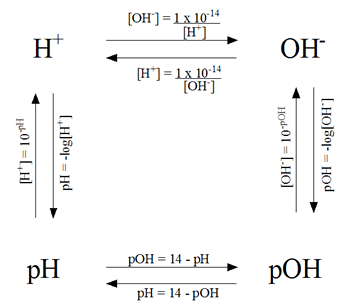
Actually, today’s lesson was very interesting! We were able to determine the pH of the a lake before and after acid rain fell on it. To do this, we needed the following equation:
Today, the topic was ion concentration. We’ve already learned about the concentration of substances and molarity in this unit, so we’re going to move onto the concentration of specific ions.
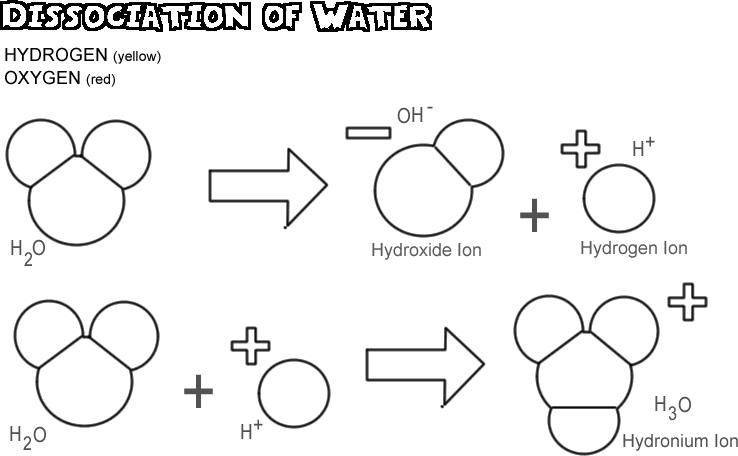
As we’ve learned before, ionic compounds are made up of two parts. The first part is the cation, which is the positively charged particle. The second part is the anion, which is the negatively charged particle. When dissolved in water, these two particles separate from each other. This process is called dissociation.
The top equation is dissociation, while the bottom is the opposite.
When writing dissociation equations, the atoms and charges must both be balanced.
Ex.) Write the dissociation of Sodium chloride.
NaCl(s)à Na+(aq) + Cl-(aq)
Ex.) Write the dissociation for Na3PO4.
Na3PO4à 3Na+ + PO43-
If the volume of the solution does not change, then the concentration of individual ions depends on the balanced coefficients in the dissociation equation.
Ex.) Determine [Na+] and [PO43-] in a 1.65 M solution of Na3PO4.
Na3PO4à 3Na++ PO43-
As always, we must start with a balanced equation. Next, we convert 1.65 M to moles, and then use our molar ratios to find the number of moles of both ions. Finally, we divide by the volume. When it doesn’t tell us, we can assume it’s 1L.
1.65 M x 1 L/mol = 1.65 mol
1.65 mol x 3/1 = 4.95 mol x 1/L = 5.0 M [Na+]
1.65 mol x 1/1 = 1.65 mol x 1/L = 1.7 M [PO43-]
Done!
Ex.) A 0.100 L solution of 0.500 M PbCl2 is added to 0.200 L solution of 0.100 M NaOH. Determine the final [Cl-].
PbCl2 + NaOH à Pb+ + 2Cl- + Na+ + OH-
Just like we did before, a balanced equation is necessary. In this equation, we need to add the volumes to find the total volume. The total volume is 0.300 L. We only need to calculate the concentration of PbCl2, so we can just disregard the other parts.
0.500 M x 0.100 L/mol x 2/1 x 1/0.300L = 0.333 M [Cl-]
Today’s class was rather blue. That is, the solutions were. But, they had different shades, and of course, this was no coincidence. We were told these were solutions of copper (II) chloride, or cupric chloride.
Our task was to figure out which of the solutions corresponded to 0.1 M. No problem, we said! We decided to quickstyle this lab.
The items we worked with included the following:
Copper (II) chloride
Scoopula
Weight
Plastic container
Beaker
Erlenmeyer flask
Graduated cylinder
Here is the procedure:
1. Obtain your needed materials listed above.
2. Weight out 1.345g of CuCl2.
3. Measure 100mL of water in a graduated cylinder.
4. Mix these two substances in an Erlenmeyer flask (it’s fun to spin).
5. Pour into test tube and compare with test tube species.
How we obtained 1.345g?
Simple. To receive a molarity of 1.0, we know that there are 1.0 moles of CuCl2 in 1L. To receive our desired molarity, 0.1, we have 0.1 in 1L. Since one liter is a bit too much, we simply keep our ratio the same, of moles and liters, but decrease the numbers by 10. Now we have 0.01 moles in 100 mL. How many grams is this? Simply molar mass of CuCl2 will tell us.