Our Pages

Monday, April 30

April 30th - Naming Groups... Continued


Today, we continued our work with naming groups. Last class, we went over the rules for naming. This class we mostly did examples.

One important addition: carbon chains without functional groups are often abbreviated as R. For example, R-OH would be alcohol.

Here are the examples we went through:

Ex.) Draw: 2, 3 diphenyl 3 ethyl 1, 5 pentadiol


To draw this compound, first draw the parent chain. Afterwards, attach two OH groups to carbons 1 and 5 on the parent chain. Finally, add two benzene side chains and an ethyl at the appropriate places. 

Ex.) Draw: Phenol


This is a special compound. Phenol consists of a benzene attached to a single OH group. 

We also learned about aldehydes. Like ketones, aldehydes have an oxygen double bond. However, in this case, the oxygen is bonded on the end. The suffix for the compound is ‘-al’.

The simplest form is methanal, which is better known as formaldehyde.


We also started our study of other functional groups.

The first one we learned of is carboxylic acid.

For carboxylic acids, there is a double bonded oxygen (an aldehyde) and an alcohol functional group on the last carbon. The suffix for this compound is ‘-ioc acid’.

Ex.) Draw: 3 chloro 2 methyl butanoic acid


To draw this compound, first draw the parent chain. From there, add the OH group and the double bonded oxygen on the first carbon. Finally, add your side chains. Done!

That’s it for today’s lesson. Next class, we can expect to continue learning about functional groups.

Here's the vid:


Posted by Michael.

Thursday, April 26

April 26th - Naming Compounds


Today we discovered more molecules. Here they are:

Halides:
            Identify halogen elements.
            Name parent chain.
            Treat halogen groups as side chains. Ie. fluoro, chloro, etc.
            Name other side chains.
This functional group is also known as halocarbons.

Ketone:
            Identify a double bonded oxygen group (not on start of end of parent chain)
            Name the parent chain. (ending will be –one)
            Lowest number for double bond.
            Add other side chains.

Ethers:
            Identify carbon chains on ‘ether’ side of an oxygen atom.
            Oxygen can be treated like the parent chain.
            Side chains are listed in lowest number of C.
                        Order of this? Who knows? Just write alphabetical order. 


Examples are on the next blog.

Did you know methanone or ethanone do not exist?


Posted by Andrew.

Thursday, April 19

April 19th - Alicyclics and Aromatics


Today, we learned about alicyclics and aromatics.

Carbon is capable of forming 2 kinds of closed loops. Alicyclics are loops usually made with single bonds. If the parent chain is a loop, standard naming rules apply (except ‘-cyclo’ is added before the parent chain).

In this example, we have cyclopentane. It’s simple, as there are no side chains.


Numbering can start anywhere, but side chain numbers must be the lowest possible.

Here are a few more examples:

Ex.) Draw: 1, 3, 5 trimethyl cyclohexane


This one is pretty easy. First, we draw the cyclohexane (which is a carbon chain of 6 with the ends connected). We then add side chains (methyl) at three spots. Easy.

Ex.) Name: 


The parent chain here is cyclobutane. There are 2 methyl side chains, both at position 1. Therefore, the name is 1,1 dimethyl cyclobutane. 

Loops can also be in side chains. The same rules apply for naming, except the side chain is given the ‘cyclo-‘ prefix.

Here's an example:

Ex.) Draw: 2 methyl 3 cyclopropyl pentane

This is done by first drawing the parent chain (5 carbons). Then, we add the methyl at the 2nd carbon. Finally, we add the cyclopropyl at the third carbon. Done!

Benzene (C6H6) is a cyclic hydrocarbon with unique bonds between the carbon atoms. Structurally, is can be drawn with alternating double bonds:


In the case of benzene, all 6 carbon-carbon bonds are identical and really represent a 1.5 bond all around. This is due to electron resonance. Another way to thing about it is that the electrons are free to move all around the ring. We can draw benzene like so:


Benzene can be a parent chain or a side chain. As a side chain, it is called ‘phenyl’.

Here's an example with benzene:

Ex.) Draw: 1, 2, 3, 4, 5, 6 hexamethyl benzene


First, draw the benzene. Then, simply add 6 methyls. 

As always, the obligatory video:


Posted by Michael.

Monday, April 16

April 16th - Alkenes and Alkynes


As we know by now (or should know), carbon can form double or triple bonds with other carbon atoms. When there are only single bonds present, it is considered a saturated compound, because all possible bonds are bonded to other atoms. On the other hand, double or triple bonds, present in alkynes and alkenes, are unsaturated. When there are multiple bonds, fewer hydrogens are attached to the carbon atom.

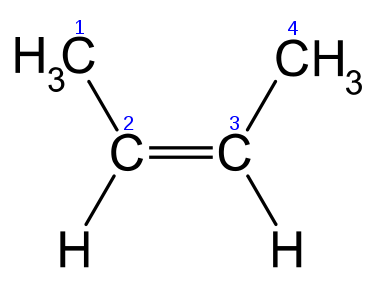
The rules for naming alkenes and alkynes are almost identical. However, remember this: The position of the double/triple bonds always has the lowest number and is put in front of the parent chain. For example, in the photo below:


This molecule consists of four carbons. The double bond occurs at 2. Therefore, this is 2-butene. 

Let's review some of the rules, just in case:

  1. Find the longest, appropriate parent chain
  2. Number the base chain so that side chains have the lowest total value
  3. Name each side chain
  4. Add some numbers
  5. List the side chain alphabetically (if you encounter the same letter, then the one with the lowest number takes precedence)
  6. If you have two or more double/triple bonds present, you will need to add a multiplier right before the '–ene'/'-yne' ending.

That is it! Let's try one:

Name this: 


Let's count the parent chain: It consists of four carbons.
Lowest numbering of alkenes: 1,3
Therefore, this is: 1, 3 butadiene

There are also these fancy structures that go by the name of –cis and –trans. This applies only to alkene groups, specially butene (but not restricted to it).


If the adjacent carbons are on the same side, then its cis ___. If it’s on the opposite sides, it is trans ____. There is also a possibility that it is neither cis nor trans. How does that look? Well, try it out yourself.


Posted by Andrew. 

Thursday, April 12

April 12th - An Intro to Organic Chemistry


Today, we started organic chemistry.

Organic chemistry is the study of carbon compounds. As we know, carbon can form four covalent bonds. This property allows it to form long chains, rings or branches with other carbon compounds. The variety and number of compounds carbon can form is astounding! It’s interesting to note that there are 17 000 000+ organic compounds, but less than 100 000 inorganic compounds.

The simplest organic compounds are made up of carbon and hydrogen.

CH4

CH3CH3

As you can see above, there are two ways to write the formula for a compound: condensed and structural. For example, CH3CH3 would be the condensed formula, while the image shows the structural formula.

We also learned that saturated compounds have no double or triple bonds. The compounds with only single bonds, which we are currently studying, are called alkanes and always end in ‘-ane’.

Another note: isomers are different compounds with the same empirical formula (like C5H2).

There are 3 types of organic compounds:
  1. Straight Chains
  2. Cyclic Chains
  3. Aromatics
We focused solely on straight chains today.

To name them, first circle the longest continuous chain and name this as the base chain.


For example, in the following compound, there is a 7 carbon chain. The longest chain can be identified as the longest path that can be made without going over the same carbon twice. Since there are 7 carbons, we can use the prefix ‘hept-‘ to identify the chain. Here are the guidelines for naming the chains:

  • 1 carbon – meth
  • 2 carbons – eth
  • 3 carbons – prop
  • 4 carbons – but
  • 5 carbons – pent
  • 6 carbons – hex
  • 7 carbons – hept
  • 8 carbons – oct
  • 9 carbons – non
  • 10 carbons – dec

We also know that there are only single bonds, so the suffix is ‘-ane’. Therefore, the compound’s primary name is ‘heptane’.

We must also name the side chains. We must number the side chains so that they have the lowest possible aggregate number. Here, we would start counting from the left. The side chains are only one carbon long, so they take the prefix ‘meth-’ and the suffix ‘-yl-. There are three of these, so we give it another prefix: ‘tri-’.

Following all of these rules, the compound is 3, 3, 5 trimethyl heptane.

With that out of the way, now we can do some examples.

Ex.) Name:

This one is pretty easy. The parent chain is 5 carbons long, so it is pentane. Then, numbering properly, we get 2, 2 dimethyl for the side chains. Therefore, the compound is 2, 2 dimethyl pentane. 

Ex.) Draw: 2, 2 dimethyl hexane.


This one is also very easy. First, draw the parent chain. Then, simply add a methyl at the second carbon in the chain:

That's it! As always, he is the video:


Posted by Michael.